
Words by Amy Bond, interview by Amy Bond and Alice Galbraith, photo credits to Alice Galbraith
Gurriers are a fiery, noise rock/post-punk band from Dublin. Their fast-paced, politically charged music can’t help but stir up a crowd into a sweaty frenzy. After the release of their second Album Nobody’s Coming to Save You, they’ve been touring the UK and landed in Bristol on 22nd October to play at Electric. BURST landed tickets to the gig where, along with their support Tramhaus, Gurriers put on a show filled with dancing, sweating and some really interesting messaging.
Before the gig, we spoke to lead singer Dan Hoff to ask him some of our burning questions about “Nobody’s Coming to Save You”.
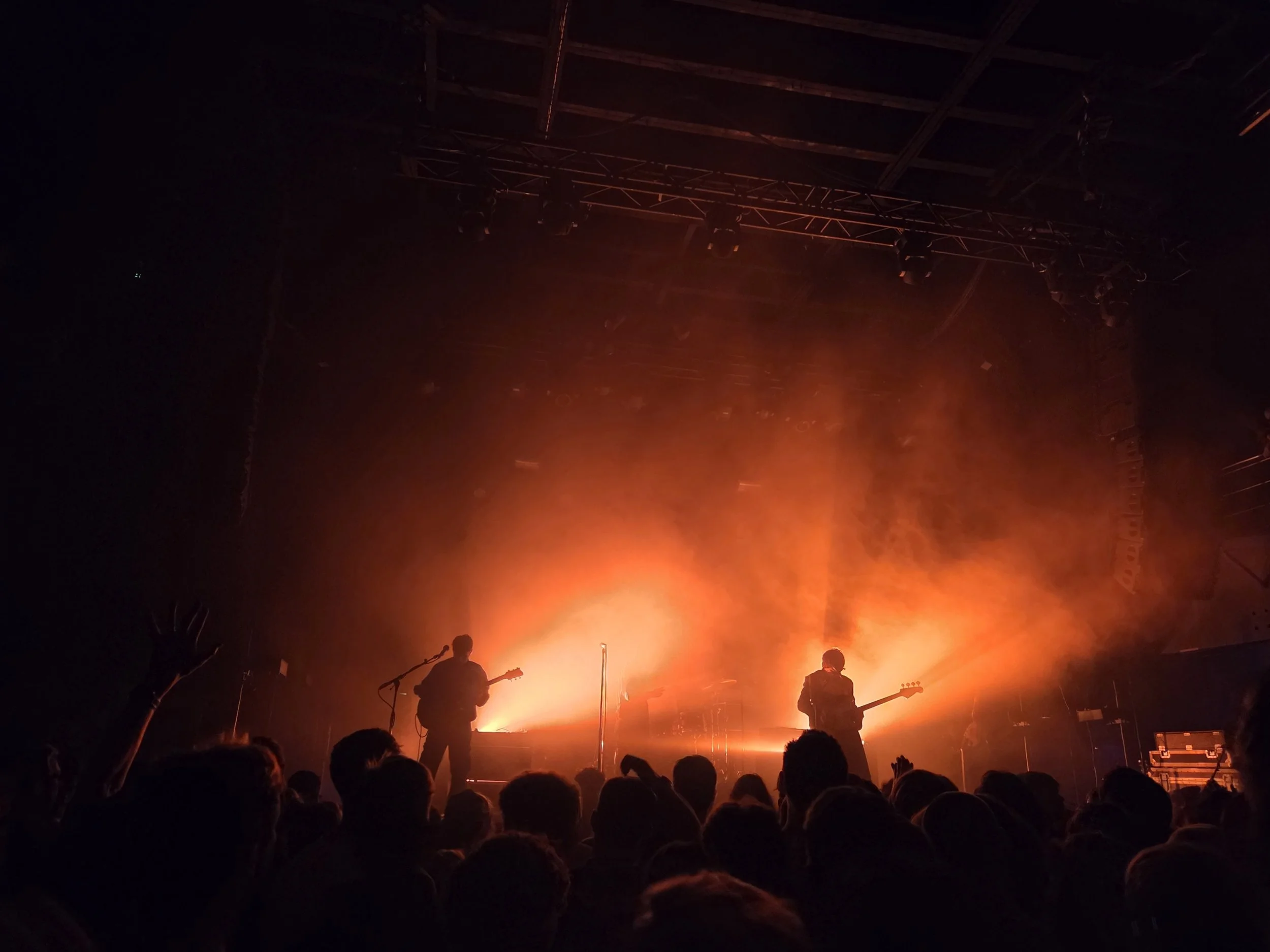
Gurriers on stage at Electric
BURST: You said previously Nobody’s Coming to Save You was written based off a bad review saying that you have problems but give no solutions. Music has been used in protest and politics since it was invented. In what way do you think releasing political music can help build political and activist momentum?
Dan: Growing up and listening to certain artists, from Bob Dylan to Rage against the Machine, they’re not really trying to change anyone’s views, they’re just trying to give their own. As artists ourselves, we’re looking at more like a journalistic approach. We try to state the facts of what’s happening here and you make up your own opinion if you’re for or against that reason. So people are going to listen to, let’s say, Nobody’s Going to Save You and think that I’m being a bit too flippant, or that I’m being a moan bag, or some other people are going to listen to me and expect me to rally them all up in arms and bring them out for the protest - but that’s not the case. It’s more to write something to say that, if you believe the same as me, that’s great. Hopefully we can one day do something about it because all of these issues are really scary and detrimental to us as a whole and it feels like I don’t want to just talk about it with friends all the time. I’d rather try and do something creatively… You know?
B: So, it’s like having a release, a place you can talk about it?
D: Yeah, it’s a cathartic experience being about to perform it. You can bring a communal kind of feeling and energy to a room.
It’s interesting what Dan says about bringing a communal energy to the room, as that group mentality is really palpable at the gig. A lot of Gurriers’ music is filled with political pressure, both on society to change but also on individuals who have felt the pressures and challenges of modern-day life. When at the gig, not only do you feel the pressure in the intense drumbeats, distorted guitars and in Dan’s lyrics, but you also feel the physical pressure of the crowd – sweaty bodies crushed together in one moving unit. It really does help release some of the tension Dan talks about in a creative way.
B: You’ve previously mentioned that you engineer your songs to manipulate how the audience moves. For all the budding artists in Bristol, what is your number one tactic for creating a song that gets people to move and dance?
D: It has to be a thing where it’s an interactive moment – it makes the crowd feel like they’re part of the song. We never really look for moments while we’re writing them. Once we realize, we reverse engineer it in a way where it’s like, oh, that can be a moment. That can be like the moment in Des Goblin where it all goes down and the dynamics change. It’s a lot more elongated and everything’s slow. That allows the crowd to kind of feel like they’re engaging with us and they’re following the rhythm as the song builds up. And it has to be, again, a communal thing. We can only give a certain amount of energy if the crowd gives a certain amount of energy and vice versa.
B: How does that sort of energy of playing live compare to recording in the studio? You’ve done a really good job of capturing the energy of those live performances on the album but what were the practical challenges of that?
D: Well, we actually recorded the drums, guitars, all of the rhythm section live anyways. The first album is basically live as well in ways, and then we just overdubbed a lot of the stuff. We wanted to get the real live feel, and if you want to get the live feel, it needs to be in the room live. A lot of the vocals were done in a different studio over time after time and stuff. We wanted to capture this thing like, it’s like lightning in a bottle, it’s a very energetic thing. And [Mark] Bowen from IDLES, wanted to basically capture that and male it as live sounding as possible in the room, because the only way we can do that is you go in there and you make those mistakes, you go in there and you make it as imperfect and as rough and ready as you can and then we’ll fine tune it afterwards.
B: You mentioned Mark Bowen. He was a producer on the album alongside Lauren Humphrey. What was it like working with him?
D: Yeah, it was amazing. He opened our eyes to a lot of things that we ddn’t really take into equation ever. What we found helpful is like when we were writing a song and Mark [MacCormack], the guitarist made a mistake in one of the tunes and went back and Bowen was like, “that sounds great!” Mark was like, “No, no, no that’s a mistake.” And Bowen said, “Doesn’t matter. No one has ever heard this song before, that’s how it should be ‘cause it sounds sick.” And it’s one of those things, we’re so adamant and strong minded of what the song should sound like going into the studio that when it does go into the studio, it’s okay for it to kind of break apart and for us to allow it to have imperfections if it works because it’s like oh, actually that doesn’t need to sound like that, because this sounds cooler.
When relistening to the album, I kept an ear out for those mistakes and imperfections and I couldn’t pick them up (as Bowen said, we listeners don’t know how it’s supposed to sound) but the general rawness and authenticity of allowing those imperfections really came through. It’s one of the things I like about Gurriers – they aren’t perfectly polished manufactured music. This is something they picked up from their start in Dublin, playing in small venues and really working for their success.
In the song “Shades” Gurriers criticise the nepotism in the music industry. Coming into the interview, I thought it was more about the pressure to be a run-of-the-mill, manufactured band, but Dan gave some interesting insights into this.
B: One song that stuck out to me from the album is Shades and its criticism of the music industry. What is one way that, as a band, you’ve felt the pressure to conform to be another “copy”?
D: We’ve never had any pressure from anyone like that because we show ourselves as a band who wouldn’t listen to that anyway. What people would probably say is we sound like other bands because they’re Irish – we were ‘the next Fontaines’ and stuff. There is that kind of aspect to it as well. With the song shades, it’s mostly about the criticism of nepotism in the music industry. That is the industry’s issue and allows a lot of bands to not go through the trials and tribulations of other bands. As in playing a pub gig with a terrible little amp and in front of five people. I think you need to do that because you need to have those moments of weakness or when you gain your strength from going “That was a great gig!”. If we playing an amazing show in front of five people with a terrible amp, we can do anything. It’s not all about having loads of money and having a great team, it’s about the music.
B: As a student radio station, a lot of our listeners are in that position at the minute, what would be your piece of advice to keep them going through those sweaty pub gigs where they’re playing to five people?
D: I have a thing. If you play in front of 20 people, it’s the same as if you’re playing in front of 20,000. You don’t know who’s at the gig. Most of this game being in the industry, as annoying as it sounds, is luck and good contacts and great music. You don’t need to be amazing players, you don’t need to be incredibly talented, you don’t need to know every little note and very little thing. Those things. Good songs, good contacts if you can get them. Also just working so hard. Play those little shitty gigs, play those gigs where you have to lug an amp halfway across the city to get there because you can’t get a taxi and you’re going to be late for a sound heck. You’ve got to do them and then they’re the ones you remember the most.
There were certainly more than 20 people at Electric, but we still experienced some cool moments with the band. There was one point when the crowd started clapping and it built into a crescendo that the band played off of and turned into a segue to the next song. Moments like that only come from bands who have learnt to adapt and take advantage of every opportunity they get. If any readers are in that position, playing with a terrible amp in tiny venues, take Dan’s advice and make the most of every gig you get. And maybe invite us at Burst along… who knows, we could be interviewing you about the importance of that gig in 5 years!
B: Back to the album a little bit. On a first listen there's a real sense of hopelessness. But on the second and third, the desire for like hope and change and the belief that things can change, I think really comes through. How do you maintain that semblance of hope despite the world being as fucked up as it is?
D: It's the quote that's in the song nobody's coming to save you from Rebecca Salna, Hope After Dark. Her book is basically a book about hope and situations where people bound together and help each other in the worst kind of catastrophes or events in the world. And she says that hope is an axe that we break down doors with. And it's a communal thing. It's that age-old thing that if the working class and the labour classes and the middle class and the upper class all join forces together, they'd be able to take down the people like the billionaires and we have the strength and numbers and it's that kind of thing to hold on to. If you look at Paris right now, it looks violent and looks horrible, but people are being pushed to a level where they feel, I can't live if you are not going to let me live. I’m going to go and riot. I'm going to make sure something is done. And unfortunately, people's livelihoods and their jobs get destroyed. And that's awful – but it's a systematic problem. It's not those people and that's people being pushed too far. To me, it looks awful, but it is a glimmer of hope. When comparing “Nobody’s Coming to Save You” to their debut album “Come and see” I felt a shift between the energies that seems in line with the decline of the state of the world. “Come and See” does have that aggressive and critical edge, but “Nobody’s Coming to Save You” seems to build upon it with more emotion, vulnerability and despair. This reflects Gurriers’ growth as a band as they’ve managed to retain their original sound but with more depth and complexity.
B: Most of our listeners are students who are still, you know, trying to figure out their lives, haven't started their careers. What is one piece of advice that you can give them to avoid the mundane life you criticize in Waiting for Fisher?
D: I'm the worst worker in the world, but I was a hard worker in a way where I get stuff done, but I probably wouldn't do it very well. At the end of the day, if you're working in a certain job and you're getting paid minimum wage and it's shite money and you can barely afford rent. Like, I don't care if you're gonna make my coffee bad. I don't care if you're gonna make a mistake. Working in the industry is so much pressure on people to benefit someone else's pockets. And for me, it's basically a minimum wage, minimum work, minimum effort. Don't apply yourself just because people are like, “You should be lucky you're working with us now”. You should go out there and do what you want to do the way you want to do it. And if you want to go out there and go on the dole, go on the dole. You know, who cares? None of this matters as long as you can just survive. It's kind of how it is, you know, I was on the dole when I was with making this band. I had to quit working for a year - I couldn't afford rent, so I moved home with my grandmother. I did terrible in school. I went to a community college. I worked in McDonald's. You got to have a mindset where, let's do it. Because you only really get one go this and it's exactly how you want to make your movie script of a life. You write the script, go out and do it.
B: Speaking of movies, you said you used a three-act model when creating the track list for this album. If the album is a soundtrack to a film, which film would it be and why?
D: I was literally thinking about this recently and I was thinking it’s like Blue Valentine, the one with Ryan Gosling. It’s a very sad movie. It’s giving dark, cold movie with a high-octane action scene at the start that seems to kind of flounder off at the end.
B: Our final question is, since we’re a uni radio station, have. You got any examples of music you were listening to in uni that we can add to our playlists?
D: Oh my god, that was nearly 10 years ago. I would probably listen to a lot of fat White Family and Shame back then. I really go into a lot of 80s music, like Prefab Sprout, Talk Talk, XTC. A lot of that kind of stuff.
If you love energy, politics and a bit of a mosh, Gurriers are definitely a band to see. Their powerful messages make the album an interesting listen, although it might not be one to put on when you’re chilling out. They’re off on a tour in Europe at the minute, but will hopefullly be back in the country soon, so catch them when you can!

Nobody’s Coming To Save you is out on all platforms right now!