
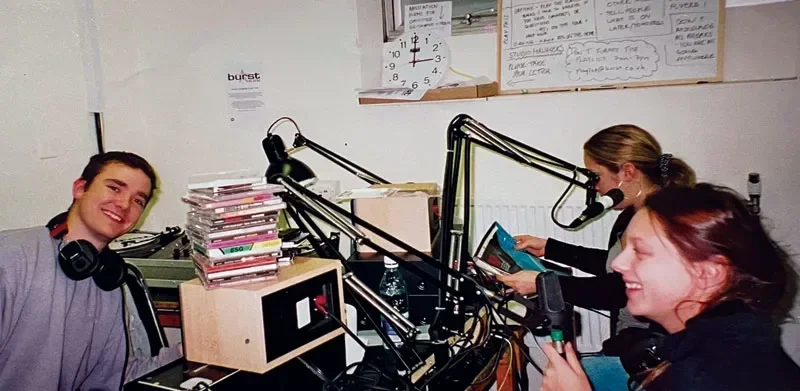
Bristol students broadcasting from St Paul’s Church, Clifton, 2000, from our own archive
Since its humble beginnings in 1997 in a converted toilet in the SU, Burst has been a way for UoB students to gain on-air experience in radio and share their ideas. Over the past 29 years, it has launched the careers of comedians Marcus Brigstocke and Danny Robins, as well as magician Danny Cox, and has become a thriving community with dozens of contributors today. But how did student radio come to be such an integral part of the university experience?
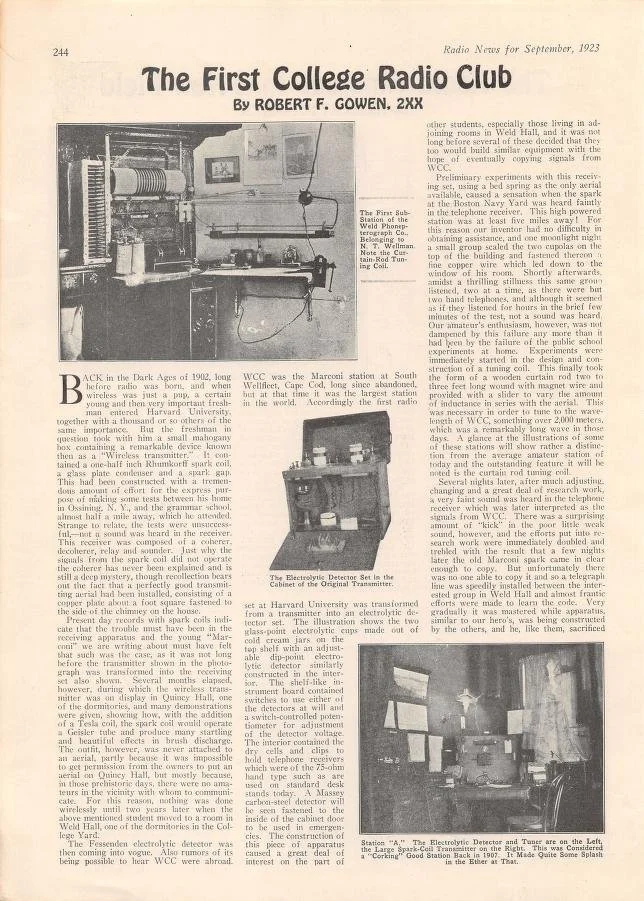
Radio News, 1923, Via Internet Archive
In 1906 at Harvard University, the College Radio Club was born. A far cry from today’s DJs and interviews in university studios, this consisted of a large mahogany box containing a transmitter, and all that the members were able to do was send telegraphs between the University’s buildings. Still, it was a start. In 1948, the Federal Communications Commission introduced non-commercial educational FM radio licenses, which lowered costs and meant that students were much more able to get on the air. By 1967, there were 220 college radio stations in the US.
The influence of student radio stations skyrocketed in the 1970s and 1980s, with college radio pioneering the independent and underground rock genre. As university broadcasts were more experimental than Top 40 stations, bands who were considered ‘too weird’ for the mainstream managed to find their audience in this space. For example, Athens, a college town in Georgia with a population of around 40 000, was a powerhouse for indie bands which were popularised by student radio - including the B-52s, R.E.M., Pylon, Method Actors and Dreams so Real.
By the ‘70s, university radio stations were a powerful way for students to influence music and pop culture in America, and even featured criticisms of the music industry’s political economy, whilst helping to develop the punk and rock scenes which defined that musical era.
Unlike the USA, it was near impossible for students in the UK to broadcast at all until the late 1960s. The BBC had a monopoly over radio on technical and programming grounds until 1972, meaning that it was unreasonably difficult to get a broadcasting license. Combined with the high cost of studio equipment, it was unfeasible for students to set up radio stations in the UK until the invention of cheaper, lightweight playback gear and transmitters in the ‘60s, when unofficial student-run stations began to pop up.
Campus Radio Hatfield at the University of Hertfordshire was first set up as a pirate station in 1960. Although illegal, it was the inaugural student radio station in the UK, and inspired other university stations to emerge. Due to their clandestine activities, these pirate stations faced barriers to operation. They were only able to broadcast late at night, and for a meagre half an hour at a time, to avoid the General Post Office detector vans from picking up on their signals and shutting them down.
Student engineers, tired of performing covert operations, found a loophole to the Marine Broadcasting Offences Act of 1967, and started using Carrier Current Broadcasting. Instead of sending radio waves through open air, they were transmitted through university building electric systems and heating pipes. In this way, Radio Heslington, a product of the University of York, was able to attain a test license in 1967. This meant they could legally transmit, but only on restricted frequencies and for specific testing, research, or demonstration reasons. The license stipulated that its signals could not extend past the Heslington campus, despite the fact that it could be picked up in some other areas of the city - albeit with very patchy signal. On 30 April 1969, it began transmitting on its legally allotted frequency, and the newly-named University Radio York became the first legal non-BBC station in the UK.
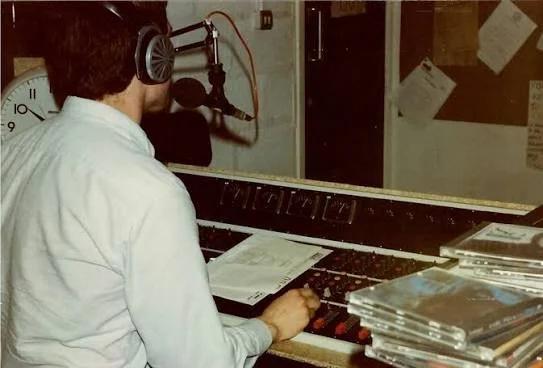
University Radio York, mysterious unknown date, from their own archive
Following the latter half of the 20th century, UK student radio has blossomed to discuss social and political views, set fashion and pop culture trends, and – critically - discover and invent new sounds and popularise artists. Their budgets remain smaller than their US counterparts, and so these stations have had less of a ‘discovery’ role in terms of finding new underground artists and skyrocketing them to fame. Still, some university stations in the UK have had a critical local music influence. For instance, The Magic Numbers, whose debut LP was dubbed ‘2005’s best Adult Album Alternative record’ by Pitchfork, received early attention from UCL’s broadcast.
Although the technological and regulatory environment have changed enormously, the central purpose of student radio has remained more or less the same over time. From the determination of the students who set up pirate stations at great risk and inconvenience to themselves sixty years ago, to the 53 student radio stations which exist across the country today - university radio continues to act as a means for self-expression and accessing otherwise unattainable journalistic and broadcasting opportunities.
If you’re interested in learning more about the history of Burst as a station, take a look at our ABOUT PAGE